
Record High Activity on Solana Despite 33% Drop in SOL Value During Q1
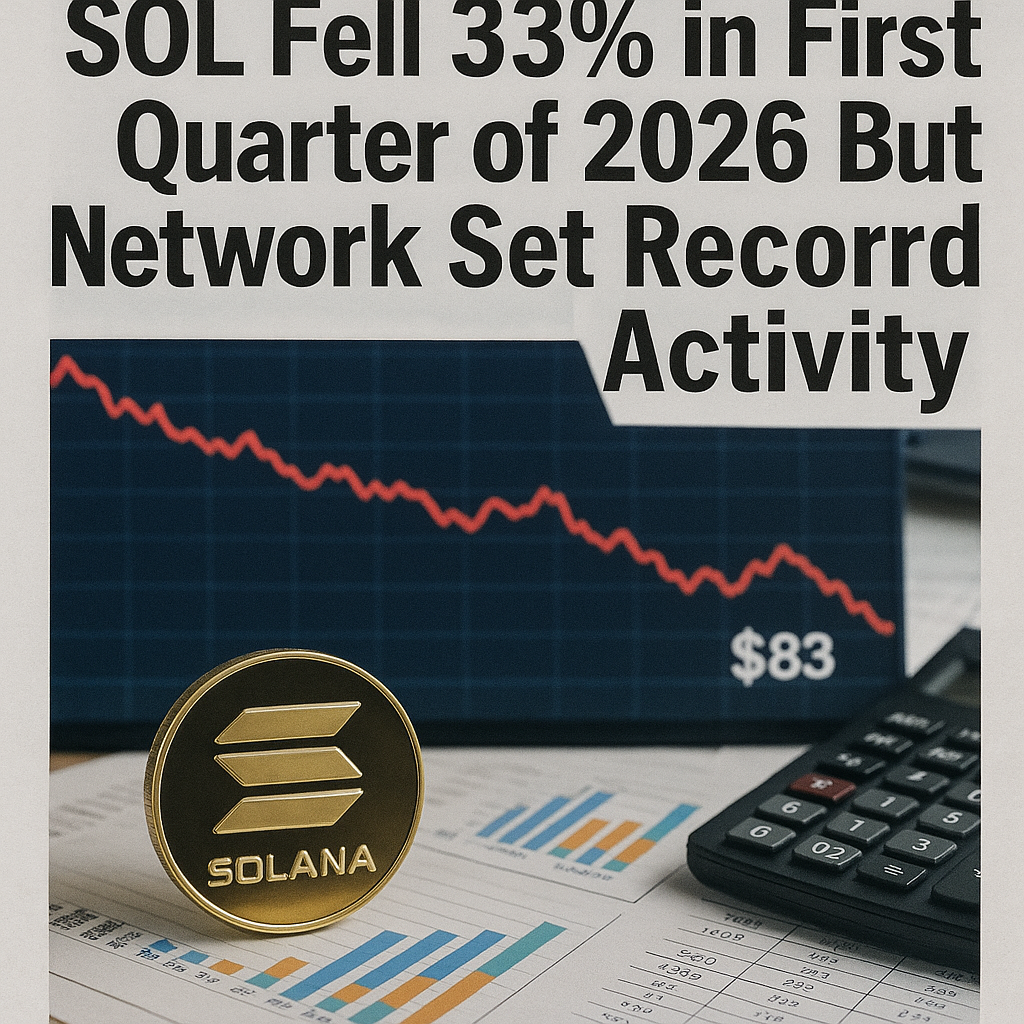
In the first quarter of 2026, the value of SOL experienced a significant decline, dropping 33% to approximately $83. However, a recent report from Messari, titled Q1 State of Solana, reveals a more complex narrative than what the price drop indicates. While dollar-based metrics showed a decrease, the Solana network achieved new milestones, including record daily transaction volumes and an increase in the market capitalization of real-world assets to over $2 billion, all while maintaining stable validator revenue. The report highlighted that the average daily non-vote transactions reached an all-time high of 112.6 million, a 50% increase from the previous quarter, and 15% higher than the previous record set in Q2 2025. This indicates that activity on the Solana network was at its peak, contrasting sharply with the decline in price. Furthermore, the Chain GDP, which measures total application revenue, remained steady at $342.2 million, slightly up from $341.8 million in Q4 2025. Notably, Pump.fun led the revenue generation with $124.7 million, reflecting a 17% quarter-over-quarter increase, while the trading app Axiom experienced a 36% rise, earning $42.4 million. On the other hand, a new platform called Bags, which enables users to share trading fees with social media accounts, saw a staggering 1,347% increase in revenue to $11.5 million, driven by a surge in meme coin trading tied to open-source AI projects in January. However, this momentum proved short-lived as revenue for Bags plummeted 85% month-over-month in February, illustrating the rapidly changing dynamics within Solana's application layer. Notably, DeFi's total value locked (TVL) declined 22% quarter-over-quarter, now at $6.16 billion, closely mirroring SOL's price drop without significant user outflows. Solana's share of the total DeFi TVL remained relatively unchanged at 6.7%, with Kamino emerging as the leading protocol, boasting $1.72 billion, slightly ahead of Jupiter at $1.69 billion. Drift's operations were adversely impacted by a $285 million exploit linked to a sophisticated social engineering campaign attributed to North Korean threats. In terms of Real Economic Value, defined as the fees and miner-extractable value tips paid to validators, it witnessed only a minor dip of 1%, settling at $89.5 million, making Solana the second-highest among networks, following Hyperliquid's $156 million. A standout trend in Q1 was the increasing prominence of real-world assets, with Solana's market growing by 43% quarter-over-quarter to $2.01 billion. BlackRock's BUIDL tokenized money market fund doubled to $525.4 million, bolstered by Anchorage Digital's commitment to custody support, with the firm holding approximately 81% of the total on-network supply by the end of the quarter. Ondo Finance also made significant strides, launching over 200 tokenized US stocks and ETFs, including the same-day tokenization of BitGo stock on the day of its NYSE IPO. While the stablecoin market cap on Solana remained just below $15 billion, its composition shifted, with USDC declining by 21% to $7.83 billion yet still constituting 53% of the total. In contrast, USDT rose 34% to $2.89 billion, and World Liberty Financial’s USD1 climbed 473% to $883.5 million, primarily due to Binance reallocating customer holdings to Solana.
Leave a Comment