
U.S. Stocks and Futures Slip as Oil Prices Surge Due to Iran Tensions: Market Overview
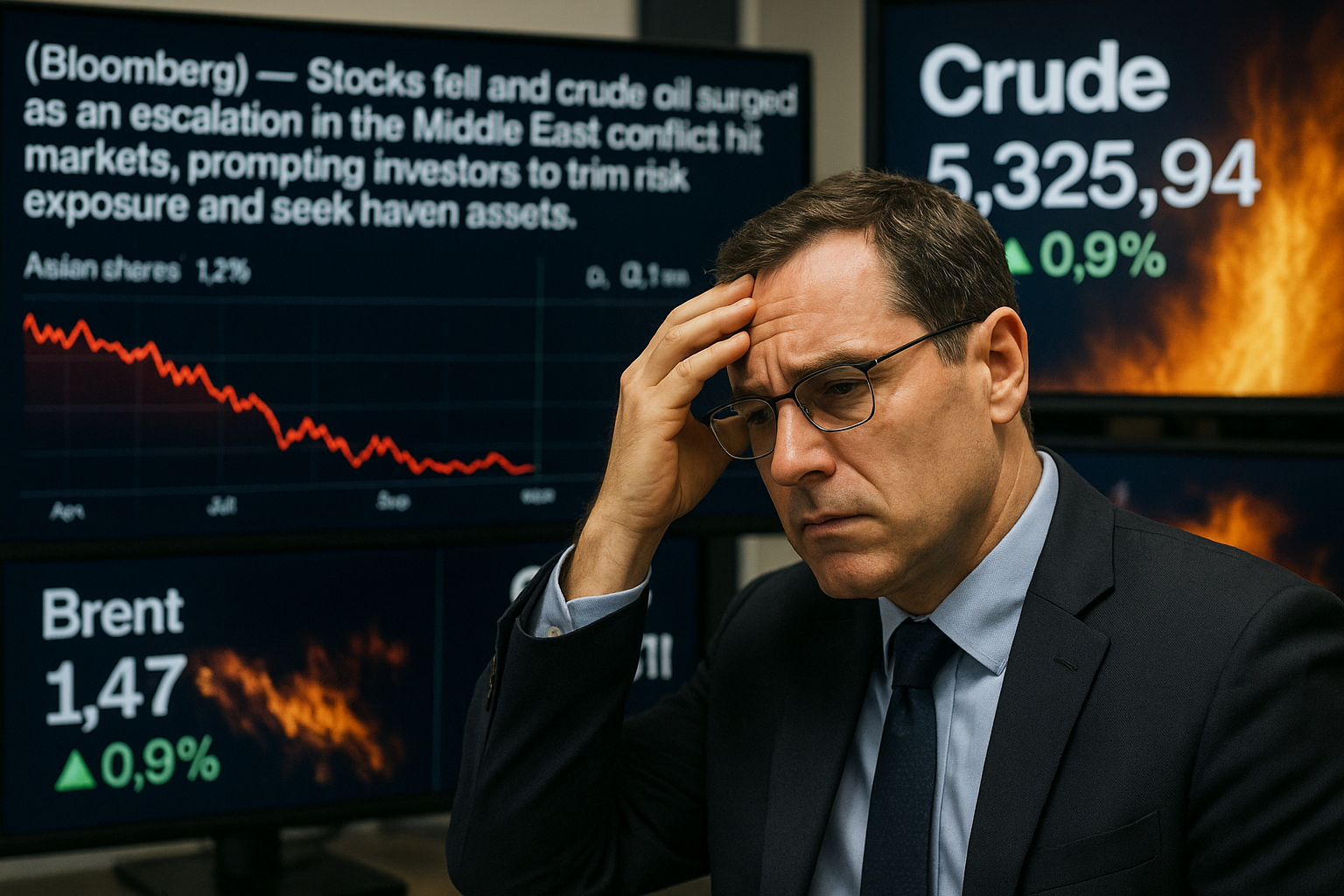
(Bloomberg) - Stock markets declined while crude oil prices soared amid heightened tensions in the Middle East, prompting investors to reduce their risk exposure and move towards safer assets. Asian markets dropped by 1.2%, with U.S. stock index futures down by 0.6%, although they recovered from earlier lows. Brent crude prices spiked up to 13% before settling back, as increased conflict significantly impacted the global oil market, particularly with the effective closure of the Strait of Hormuz. In related news, President Donald Trump indicated to the New York Times that he might be willing to lift sanctions on Iran if its new leadership shows a pragmatic approach. Reports from the Wall Street Journal suggest that Iran is eager to resume negotiations with the U.S. Attention remains focused on the Strait of Hormuz, a vital channel for oil supply worldwide. Amid the risk aversion, several safe-haven assets gained traction; gold rose 0.9%, trading at approximately $5,325 per ounce, though it retreated from session highs. Conversely, the dollar softened, and Treasury yields reversed earlier gains. Adam Hetts, Global Head of Multi-Asset at Janus Henderson, noted that markets seem to be pricing in a limited conflict scenario, with broader investment risks remaining manageable unless tensions escalate significantly. Investors are grappling with heightened concerns regarding artificial intelligence and potential vulnerabilities in credit markets, all while navigating historically high equity valuations. The unfolding military actions in Iran and the wider region pose dangers to global trade routes and could hamper travel, raising significant focus on oil prices and inflation, especially after U.S. stocks experienced their largest decline since April. Bloomberg Economics warned that a closure of the Strait of Hormuz could lead to prices surging as high as $108, given that about 20% of global oil traffic traverses this chokepoint. Digital signals suggest a near halt in oil-tanker traffic through Hormuz, exacerbated by recent attacks on ships near the Persian Gulf, raising concerns about potential supply constraints. Josh Gilbert, a market analyst at eToro Ltd., stated that geopolitical shocks often trigger swift movements in oil and safe havens, which can dissipate if conflicts remain contained. He advised investors to brace for heightened volatility across oil, gold, currencies, and equities in the upcoming week, pointing out that while energy prices have surged, other market movements remain relatively stable without widespread panic. Barclays Plc strategists cautioned against hastily buying on dips, stressing that this geopolitical situation may persist longer than typical instances that dissipate quickly. They highlighted risks including possible U.S. casualties and disruptions in Hormuz traffic. While some see potential buying opportunities should equities drop significantly, the overall risk-reward balance appears less favorable currently. Ongoing geopolitical uncertainties compound existing market challenges, particularly as AI-related disruptions have affected U.S. equity markets for weeks, contributing to what's referred to as the 'AI scare trade.' Concerns over private credit, essential for tech funding, have also been a drag on investor sentiment. Price data released on Friday revealed higher-than-expected U.S. producer prices even prior to Monday's oil spike. An enduring rise in oil prices would complicate the outlook for Treasuries, as increased safety-seeking activity typically lowers yields, while higher energy costs could contribute to inflationary pressures, pushing yields upward. Dilin Wu, a strategist at Pepperstone, indicated that even without a formal closure of the Strait of Hormuz, rerouted vessels and increased insurance costs could still create supply tightness, introducing a fresh inflationary challenge. Amid the prospect of protracted upheaval in the Middle East and subsequent increases in oil prices, fund managers are increasingly incentivized to move away from equities towards safer investments. High valuations across global stocks and credit markets make it easier for investors to cut back on risk at a time when caution is warranted. Dec Mullarkey, managing director at SLC Management, expressed concern about the fragile state of U.S. equity markets amid rising fears of technological disruption and emerging credit issues, suggesting that higher commodity prices could trigger further sell-offs as investors look to reduce risk exposure. Key market movements include: Stocks: S&P 500 futures down 0.6% as of 10:28 a.m. Tokyo time, Japan’s Topix down 1.2%, Australia’s S&P/ASX 200 down 0.6%, Hong Kong’s Hang Seng down 1.2%, Shanghai Composite down 0.3%, Euro Stoxx 50 futures down 1.3%. Currencies: Bloomberg Dollar Spot Index up 0.2%, euro down 0.2% to $1.1783, Japanese yen down 0.3% to 156.45 per dollar, offshore yuan unchanged at 6.8683 per dollar. Cryptocurrencies: Bitcoin up 1.5% to $66,630.66, Ether up 2.1% to $1,969.54. Bonds: 10-year Treasuries yield up three basis points to 3.96%, Japan’s 10-year yield down two basis points to 2.090%, Australia’s 10-year yield down one basis point to 4.64%. Commodities: West Texas Intermediate crude up 4.7% to $70.16 a barrel, spot gold up 0.9% to $5,324.94 an ounce. This report was created with the assistance of Bloomberg Automation.
Leave a Comment