
TotalEnergies Enters 20-Year Agreement for Alaska LNG Procurement
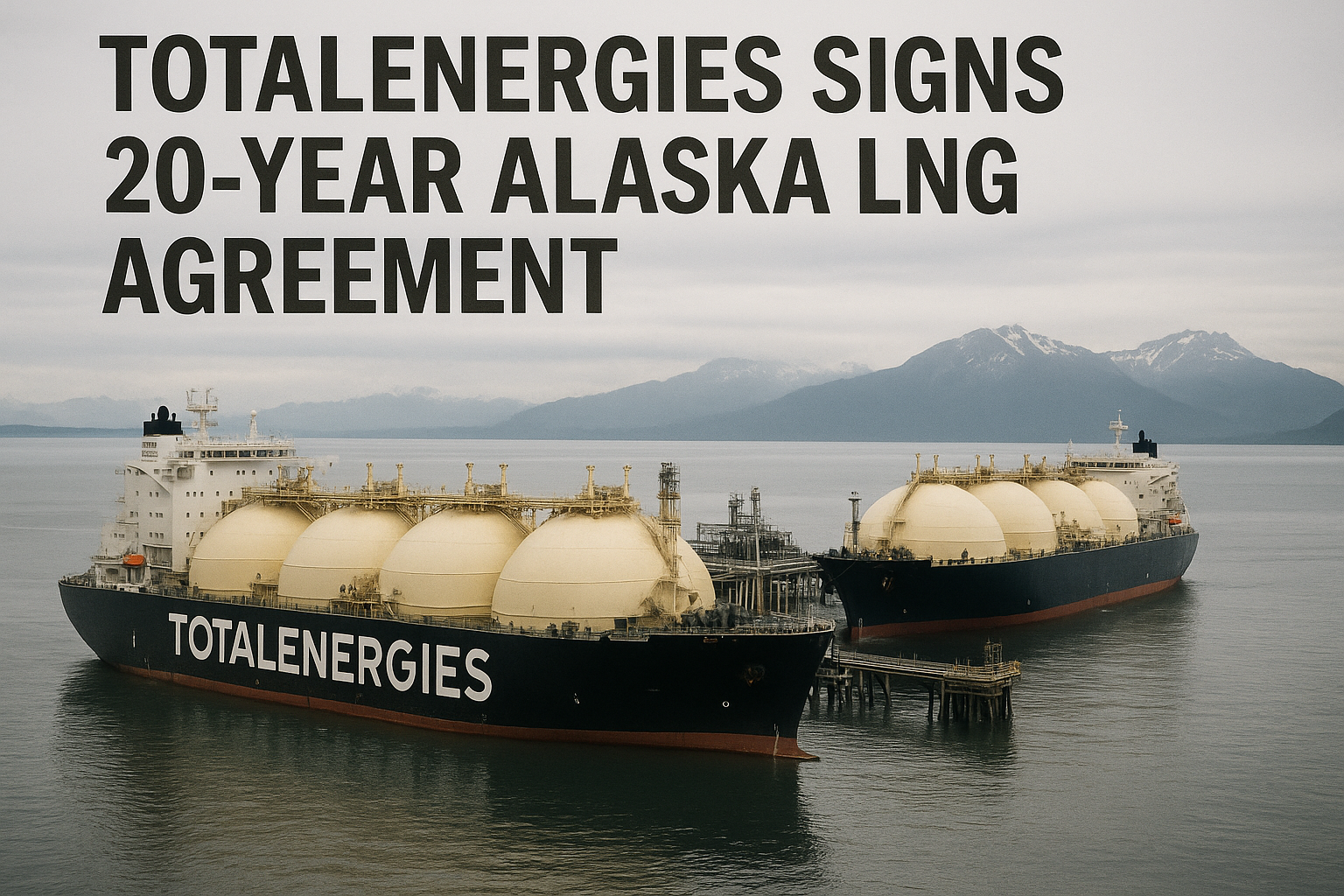
TotalEnergies has finalized a preliminary agreement for a 20-year term to procure 2 million tons of liquefied natural gas (LNG) annually from the upcoming Alaska LNG project, bolstering its status as the leading exporter of U.S. LNG and enhancing its presence in Asian markets. On Wednesday, the company announced it has signed a letter of intent with Glenfarne, the primary developer of the Alaska LNG initiative, for the long-term procurement of 2 million metric tons per annum (Mtpa) of LNG, dependent upon a final investment decision. The proposed Alaska LNG facility, located along the U.S. Pacific coast, is designed to have an export capacity of 20 Mtpa and stands as the only LNG export terminal federally authorized in that region. Its strategic Pacific location is expected to offer direct shipping routes to Asia, the largest global LNG market, potentially minimizing travel times compared to shipments from the U.S. Gulf Coast that pass through the Panama Canal. This agreement is in line with TotalEnergies' broader strategy to enhance its role as a key buyer and marketer of U.S. LNG while diversifying its sourcing across various regions. TotalEnergies was the top U.S. LNG exporter in 2025, exporting 19 Mt, equivalent to approximately 18% of total U.S. production, with most supplies directed to Europe as efforts continue to replace Russian pipeline supplies. The Alaska agreement would further shift the company’s geographic focus towards Asia, where demand for LNG is expanding due to coal-to-gas transitions, industrial growth, and energy security concerns. Direct access to the Pacific could improve cost competitiveness and logistical flexibility for Northeast Asian customers. Additionally, the project holds significant political implications. Alaska LNG has obtained federal authorization and is considered a strategic infrastructure project aimed at strengthening U.S. energy relations with Asian partners. Supporters claim that its location could alleviate shipping congestion and enhance resilience in the transpacific gas market. TotalEnergies already has a diverse North American LNG portfolio, including equity interest and long-term agreements in major export facilities such as Cameron LNG and Rio Grande LNG in the U.S., Energia Costa Azul in Mexico, and Ksi Lisims LNG in Canada. The company also retrieves volumes from Sabine Pass, Freeport LNG, and Corpus Christi. On the upstream side, it possesses gas production assets in Texas, Oklahoma, and the U.S. Gulf of Mexico. Globally, TotalEnergies ranks as the third-largest LNG operator, with a portfolio of 44 Mt per year in 2025. Its integrated business model spans upstream production, liquefaction, shipping, regasification—especially in Europe where it oversees more than 20 Mt per year of capacity—trading, and LNG bunkering. The company aims to elevate natural gas to nearly 50% of its sales mix by 2030, positioning gas as a transition fuel towards lower carbon emissions while committing to reducing methane emissions across its operations. Although the Alaska LNG contract is contingent on final investment decision, this preliminary agreement indicates increasing commercial interest in a project that has been discussed for some time without achieving a definitive approval. Should it proceed, this development would signify a notable increase in U.S. LNG export capability on the Pacific coast and solidify TotalEnergies’ pivotal position within the global LNG sector. By Charles Kennedy for Oilprice.com
Leave a Comment