
Bitcoin Secures Unprecedented $732 Billion in New Investments, Outpacing All Past Cycles Combined: Analysis
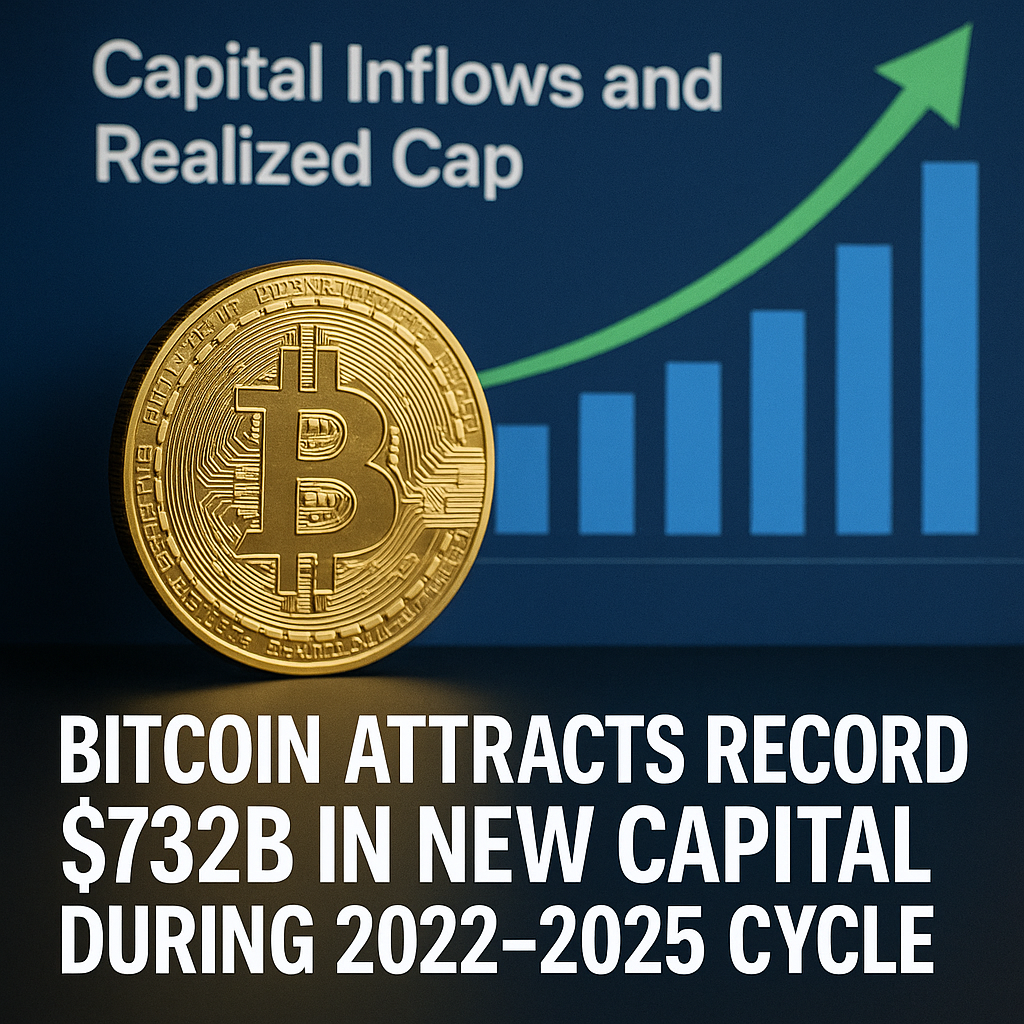
In the 2022–2025 period, Bitcoin has successfully attracted a staggering $732 billion in new investments, exceeding the total amount garnered in all prior cycles combined. This significant accumulation phase has raised Bitcoin's Realized Cap to a groundbreaking all-time high, while trading activity in the market has become more stable, extensive, and institutionalized. According to Glassnode's Q4 Digital Assets Report in partnership with Fasanara Digital, the cumulative capital inflows for this recent cycle reached $732 billion, dwarfing previous inflows of $4.4 billion from 2011–2015, $86 billion from 2015–2018, and $388 billion during 2018–2022. Monthly net inflows have varied from $30 billion to $100 billion, with October 2025 witnessing a surge that contributed approximately $39.8 billion monthly to the network, which has since tapered to around $15 billion per month. This influx has primarily been driven by stablecoin liquidity, demand for spot ETFs, and the emergence of tokenized asset rails, fundamentally altering how funds are introduced into the ecosystem. Additionally, Bitcoin achieved another significant milestone this year, with its Realized Cap hitting $1.1 trillion. Distinct from market capitalization, which evaluates the current market price of all coins, Realized Cap measures the cumulative net inflows and outflows, valuing each coin based on its most recent on-chain transaction. During the 2022–2025 cycle, Bitcoin's price surged from $16,000 to $126,000, marking an impressive 690% increase. Since November 2022, Bitcoin's market dominance has risen from 38.7% to 58.3%, attributed to a pivot toward higher-liquidity, lower-risk assets. Conversely, Ethereum's share has dropped to 12.1%, continuing its trend of underperforming against Bitcoin since the 2022 Merge. The Altcoin sector now claims 21.3% of the overall market, hampered by reduced retail engagement and limited speculative capital in comparison to prior cycles. Stablecoins constitute 8.3% of the total market, a slight increase from last year but still below their peak of 17.3% in late 2022. These assets remain essential as the primary quote currency on both centralized and decentralized exchanges, and their increasing adoption in emerging markets enhances liquidity while supporting dollar-denominated trade. Furthermore, Bitcoin's long-term volatility has declined from 84% to 43%, reflecting a structural decrease in realized volatility amid a broader market depth expansion. Short-term volatility has oscillated between 17% and 75% over one-month and three-month intervals. While lower than in previous Bitcoin cycles, these volatility levels exceed traditional equity and commodity benchmarks, suggesting the market remains responsive to changes in liquidity and trader sentiment.
Leave a Comment