
Barclays to Cut 5,000 Jobs in AI-Driven Cost-Cutting Initiative
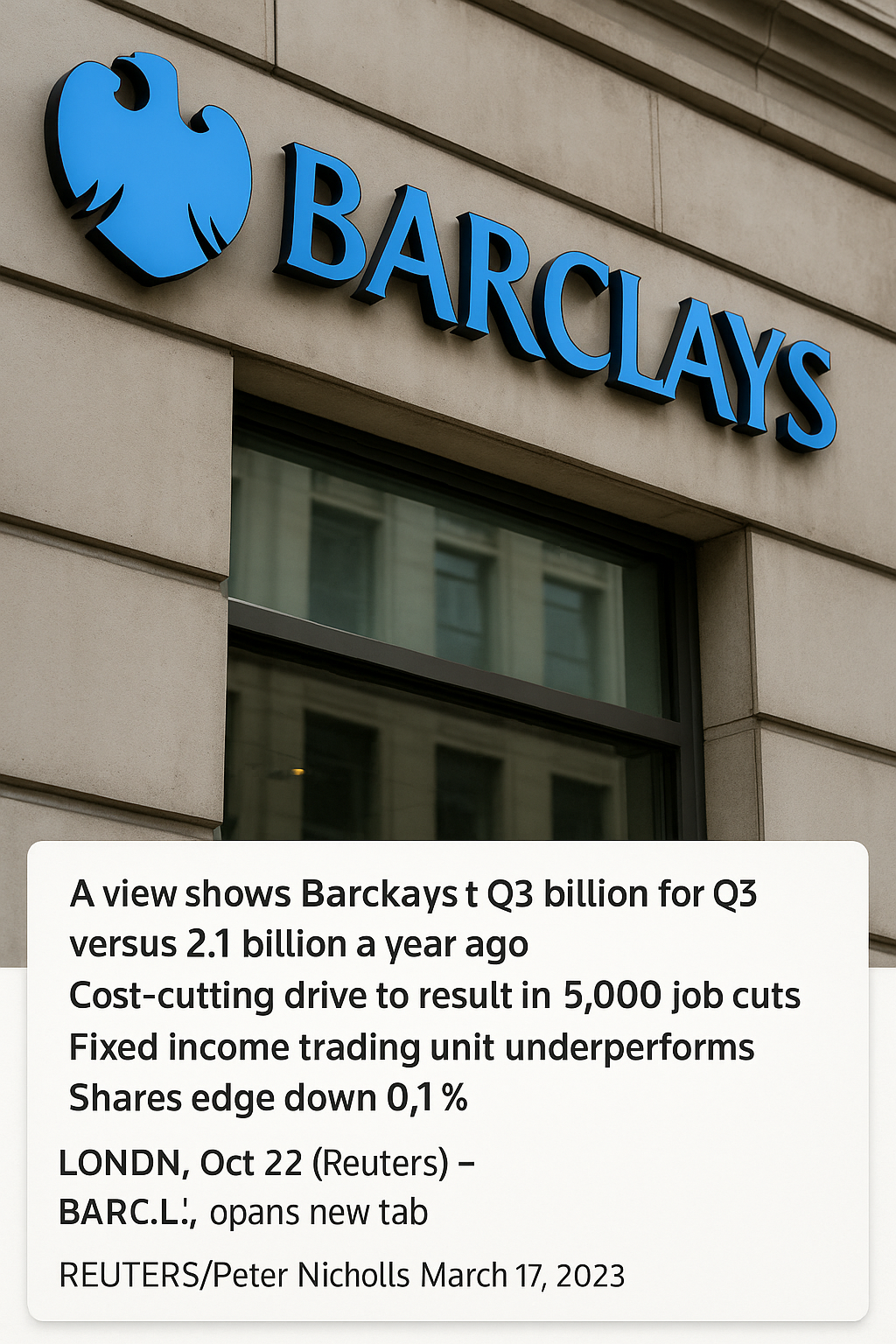
A view of a Barclays Bank branch in London, March 17, 2023. REUTERS/Peter Nicholls. Barclays (BARC.L) announced it will reduce its workforce by approximately 5,000 positions, representing 5% of its staff, as part of a strategy to leverage technology such as AI to lower fixed costs and enhance profitability. The job cuts were disclosed alongside the bank's third-quarter earnings report, which revealed a profit of £2.3 billion ($3.08 billion), a 12% increase from the previous year, yet falling short of analysts' expectations due to a disappointing performance in its fixed income trading segment. CEO C.S. Venkatakrishnan expressed disappointment over the bank's traditional strength in fixed income trading and attributed it to a volatile market and weak trading conditions in rates and credit products. The bank also reported an additional £201 million spent on 'structural cost actions' in the third quarter, part of a broader initiative to reduce staff expenses through increased technological adoption. CFO Anna Cross stated that around 60% of the job reductions would affect support functions, underscoring how AI is enabling headcount reductions in these areas. So far, 1,000 positions have been eliminated, with the rest expected to be cut by year-end. Will Howlett, a financial analyst at Quilter Cheviot, noted, 'These cuts highlight the potential of AI and automation to significantly transform the banking sector in the upcoming years.' Shares of Barclays dipped 0.1%, a relatively minor decline compared to other lenders, and have fallen 12% year-to-date, reflecting a broader downturn among European banks in the face of rising interest rates. In a note, Shore Capital commented that the earnings report was weaker than anticipated, largely due to the underperformance of the investment banking unit. As the first major European bank to release its quarterly results, Barclays could see its performance overshadowed by UK Finance Minister John Healey's first budget announcement on October 28, where new taxes on banks may be introduced. This follows the Finance Minister's ongoing deliberations about raising taxes on banks' large profits to support the Labour government's financial plans amidst climbing borrowing costs. The banking sector has contended that they are already heavily taxed compared to peers in other regions and that additional taxes could limit lending capabilities. Meanwhile, Barclays’ investment bank reported total income of £3.1 billion for the third quarter, falling short of the £3.3 billion forecast. Earnings reports from Barclays’ Wall Street rivals earlier this month emphasized the cyclical nature of investment banking revenue, with only equities trading maintaining strong performance amid a slowdown in deal-making and weaker fixed income results. Barclays’ equities revenue surged 47%, surpassing a 37% average increase among the top five U.S. banks, but its fixed income trading income saw a 19% drop to £1 billion, which was not only below analysts’ expectations of £1.3 billion but also lagged behind a 5% decline experienced by its U.S. counterparts. ($1 = 0.7461 pounds) Reporting by Lawrence White; Editing by Tommy Reggiori Wilkes and Elaine Hardcastle. Our Standards: The Thomson Reuters Trust Principles.
Leave a Comment