
Comparing Small-Cap Diversification with Large-Cap Growth: An Analysis of IWO and VOOG
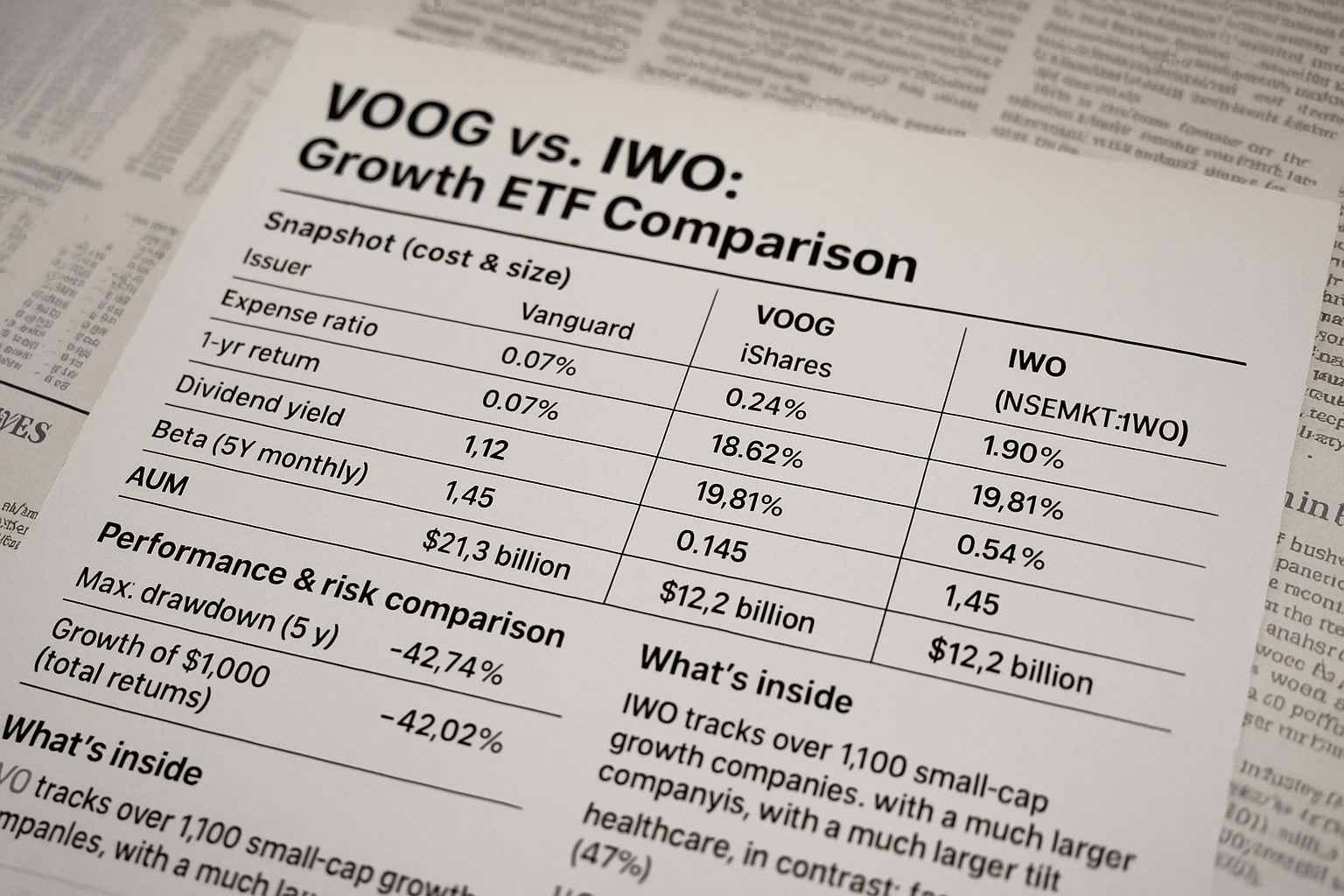
The Vanguard S&P 500 Growth ETF (NYSEMKT:VOOG) and the iShares Russell 2000 Growth ETF (NYSEMKT:IWO) both target growth stocks, yet their strategies and risk profiles are notably different. VOOG focuses on established large-cap growth companies within the S&P 500, whereas IWO encompasses a wider array of small-cap growth stocks. This distinction offers valuable insights for investors considering the reliability of large-caps versus the opportunities presented by small-caps. Here’s a financial snapshot for comparison. IWO, with its 0.24% expense ratio, has a notable edge in dividend yield at 0.54%, despite a higher cost relative to VOOG's 0.07%. While VOOG exhibits a strong 1-year return of 18.62%, IWO slightly surpasses it with 19.81%. However, IWO has experienced greater volatility, indicated by a five-year maximum drawdown of -42.02% compared to VOOG's -32.74%. Over five years, the growth of $1,000 invested in VOOG is $1,880 versus $1,127 in IWO, underscoring the contrast in risks associated with small-cap versus large-cap growth stocks. IWO's diverse portfolio includes over 1,100 small-cap growth companies primarily in healthcare, industrials, and technology. Conversely, VOOG's concentration on the S&P 500 highlights tech's dominance with 47% of its assets, largely consisting of major players like Nvidia, Microsoft, and Apple. This focus has benefited VOOG over the past five years but could pose risks if the tech sector falters. While VOOG appeals to those seeking growth from established tech firms, IWO offers diversification advantages with less exposure to any single sector. Before investing in IWO, potential buyers may want to consider renowned alternatives highlighted by The Motley Fool's Stock Advisor, which identifies top investment opportunities that have historically yielded significant returns.
Leave a Comment