
Bitcoin Long-Term Holder Supply Approaches Record Highs Despite Recent Pullback
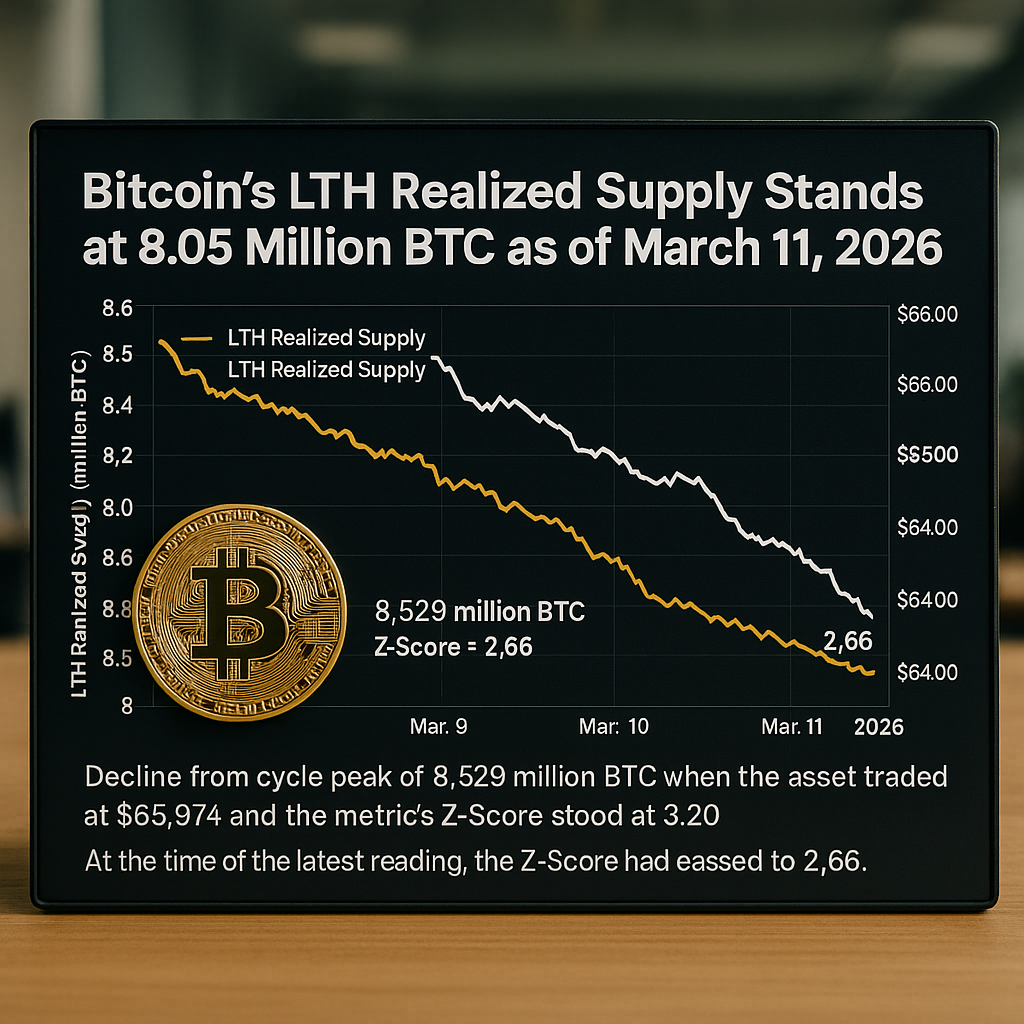
As of March 11, 2026, Bitcoin's Long-Term Holder (LTH) Realized Supply reached 8.05 million BTC, marking a decline of approximately 5.5% from the cycle peak of 8,529,671 BTC observed on March 8, 2026, when Bitcoin was valued at $65,974 and the metric's Z-score hit 3.20. The latest Z-score has since moderated to 2.66. Crypto analyst Axel Adler Jr. notes that, despite this recent dip, the level of Bitcoin held by long-term investors remains historically elevated. In comparison to previous cycles at this post-halving stage, specifically day 691 post-halving, the current cycle reveals significantly larger holdings—about 1.52 times greater than in 2020 and roughly 3.4 times more than in 2016. Adler highlights that the current Z-score of 2.66 is reminiscent of the 2016 cycle's 2.94 at the same juncture, which preceded a redistribution phase that lasted around 200 days before reaching its all-time high in December 2018. Conversely, the 2020 cycle displayed a different trajectory, with a Z-score of just 1.08 at day 691, following the Terra/LUNA collapse. Furthermore, Adler assessed the MA365 ratio, which currently stands at 1.595, lower than the 2016 comparison of 2.523 but slightly above the 1.502 seen in 2020. This indicates a moderate degree of overheating in relation to the one-year moving average. Historically, the peaks of LTH Realized Supply have occurred between days 880 and 912 post-halving, suggesting a potential timeline for another peak. However, this cycle's unique characteristics, such as institutional investments in Bitcoin ETFs locking up substantial amounts of coins, may affect the dynamics of active circulating supply and could lead to heightened accumulation among long-term holders. Additionally, the accumulation momentum is experiencing a slowdown, with the 30-day rate of change at +7.6%, significantly lower than prior cycles, where increases reached up to 87% in 2016 and 51.6% in 2020. This reduced growth rate could indicate a transition into a stabilization phase following the strong accumulation seen in early 2026.
Leave a Comment